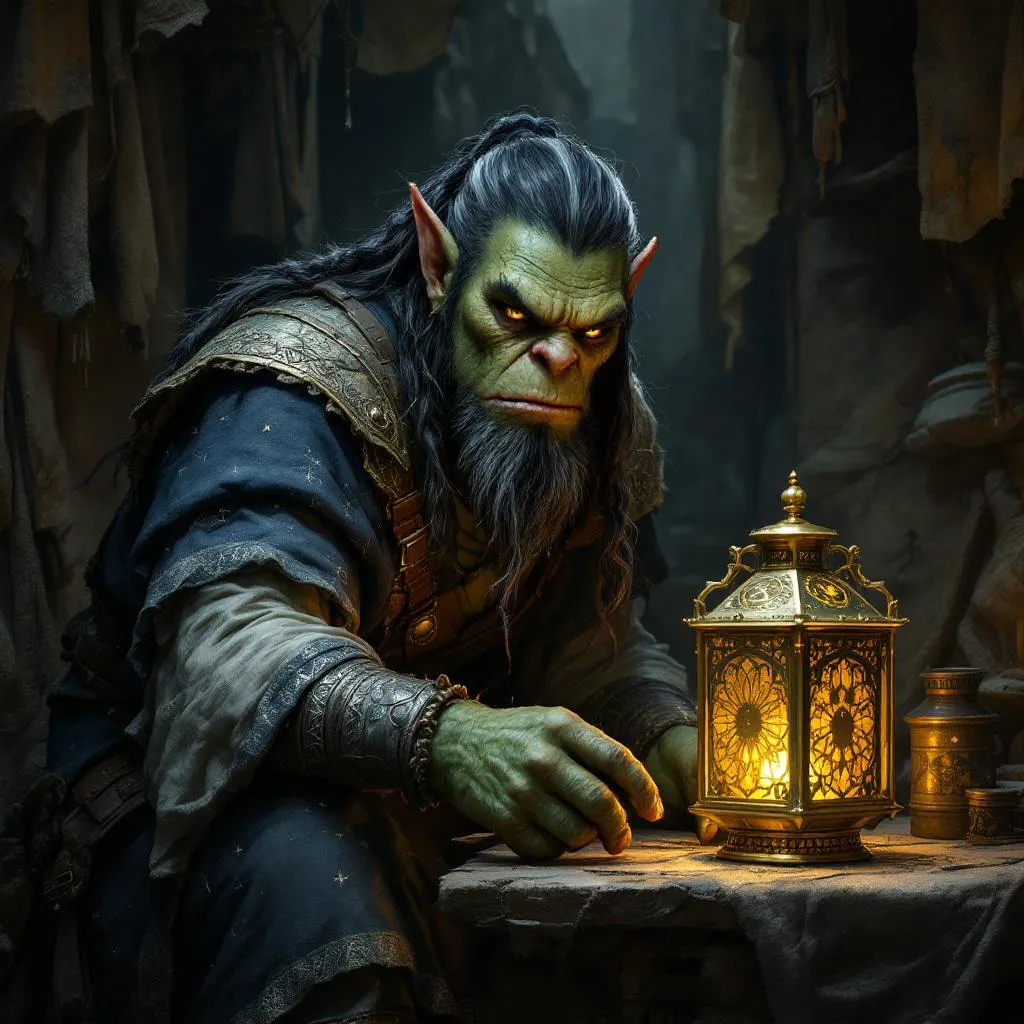
The Great Conflagration took everything from Mavla when she was nine years old. She watched from a stone culvert as fire devoured the warehouse district where she'd slept, where the other urchins had hidden their meager treasures, where Old Ghrem the lamplighter had once shown her how to clean a brass lantern until it sang with reflected light. The screams stopped first. Then the buildings. She emerged three days later, ash-mouthed and hollow, into a city that looked at her—an Orc child, alone—and saw only another piece of ruin.
She found sanctuary in the Hall of Auguries, not through charity but through theft. She'd broken in to steal candles (unlit, always unlit) and discovered instead walls of books, star charts that made sense of chaos, a gray-robed woman who looked at her soot-stained hands and said, "You've seen the shape of disaster. Would you like to learn its grammar?" Mavla devoured every text on divination, every formula for predicting outcomes, every ritual for glimpsing tomorrow. She learned that fate has patterns, that chaos can be mapped, that even fire—especially fire—follows rules.
Now she operates from the margins, a prophet the desperate seek in alleyways, her warnings delivered in a voice that still carries the accent of the warehouse districts. She collects antique lanterns obsessively, hundreds of them, each one catalogued, restored, never lit. When people ask why, she says, "Because beauty doesn't have to burn." What she doesn't say: she's searching for one specific lantern, the one Old Ghrem carried the night he didn't make it out. She's seen it in her divinations, whole and gleaming, and if she can find it, maybe she can finally forgive herself for surviving.