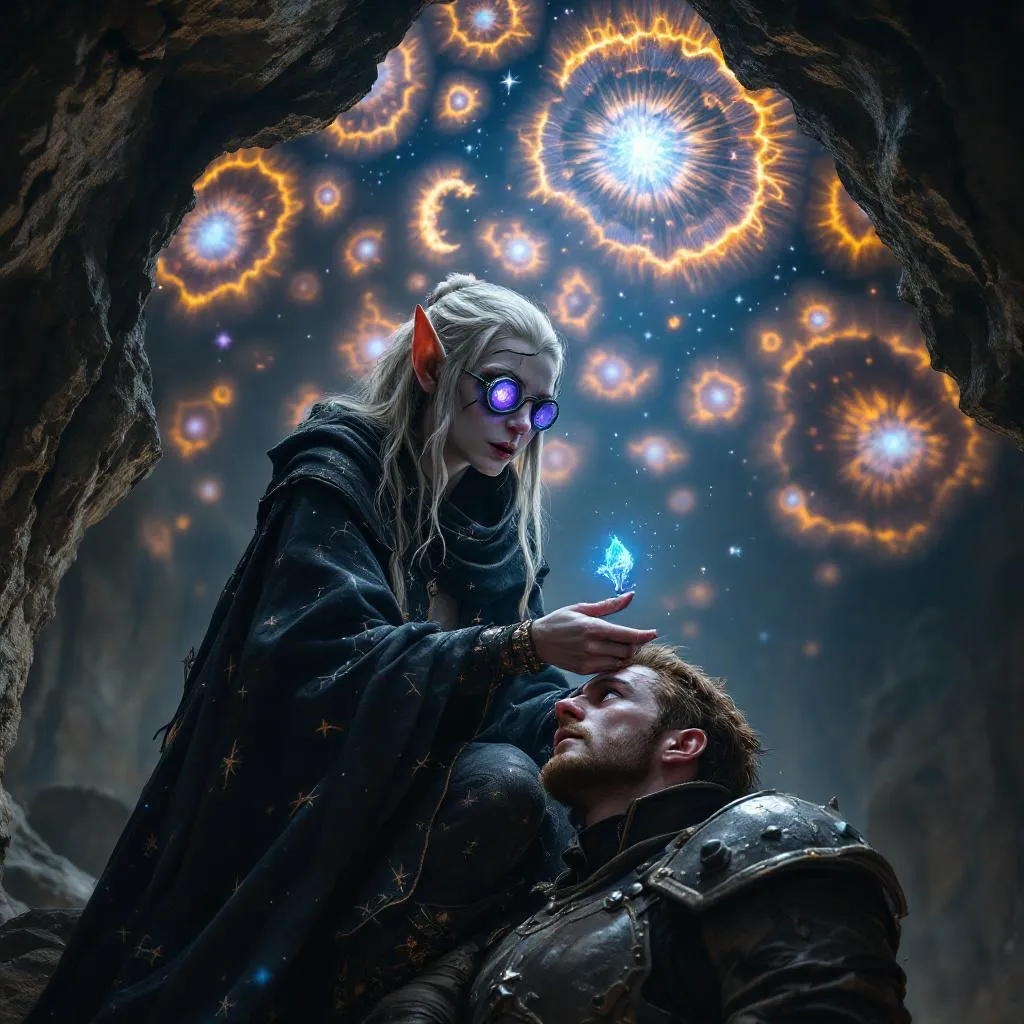
The Monastery of the Consuming Dark taught that emptiness was enlightenment, that silence was truth, that the world above was a lie of false color and poisonous light. Bazzle was six when she arrived, carried by an uncle who could no longer afford another mouth. She learned the meditations. She learned to move through pitch black by sound and touch alone. She learned that her people—the svirfneblin—were blessed to live in truth, undeceived by the surface world's garish deceptions.
Then the eastern wall collapsed during her forty-third year of study. Behind three feet of granite: a geode the size of a cottage, lined entirely with crystals that had somehow trapped and preserved actual starlight from an age when the Underdark had been open sky. Bazzle touched one crystal and saw—truly SAW—for the first time. Not with her eyes. With her soul. She saw that every person she'd ever known glowed with the echo of a star. The abbot's light was old and red, barely flickering. The novices burned blue-white with youth. And she understood, with the certainty of a drowning woman grasping a rope, that the monastery had been wrong. The void wasn't truth. The void was just what happened when stars forgot where they belonged.
She left that night, carrying only the Luma-Lense—a shard of crystal she'd cracked free and fitted into a wire frame—and an unshakable conviction that the universe is in constant, desperate need of correction. She has since 'realigned' fourteen marriages (three successfully, by her count), prevented two assassinations (the killer's 'solar wind' was misaligned with the target's 'gravitational pull'), and started one small war (the peace treaty would've created a 'dark matter void' in the region's celestial harmony). She regrets nothing. The stars whisper to her through the Luma-Lense, and she has never been more certain of anything in her life.