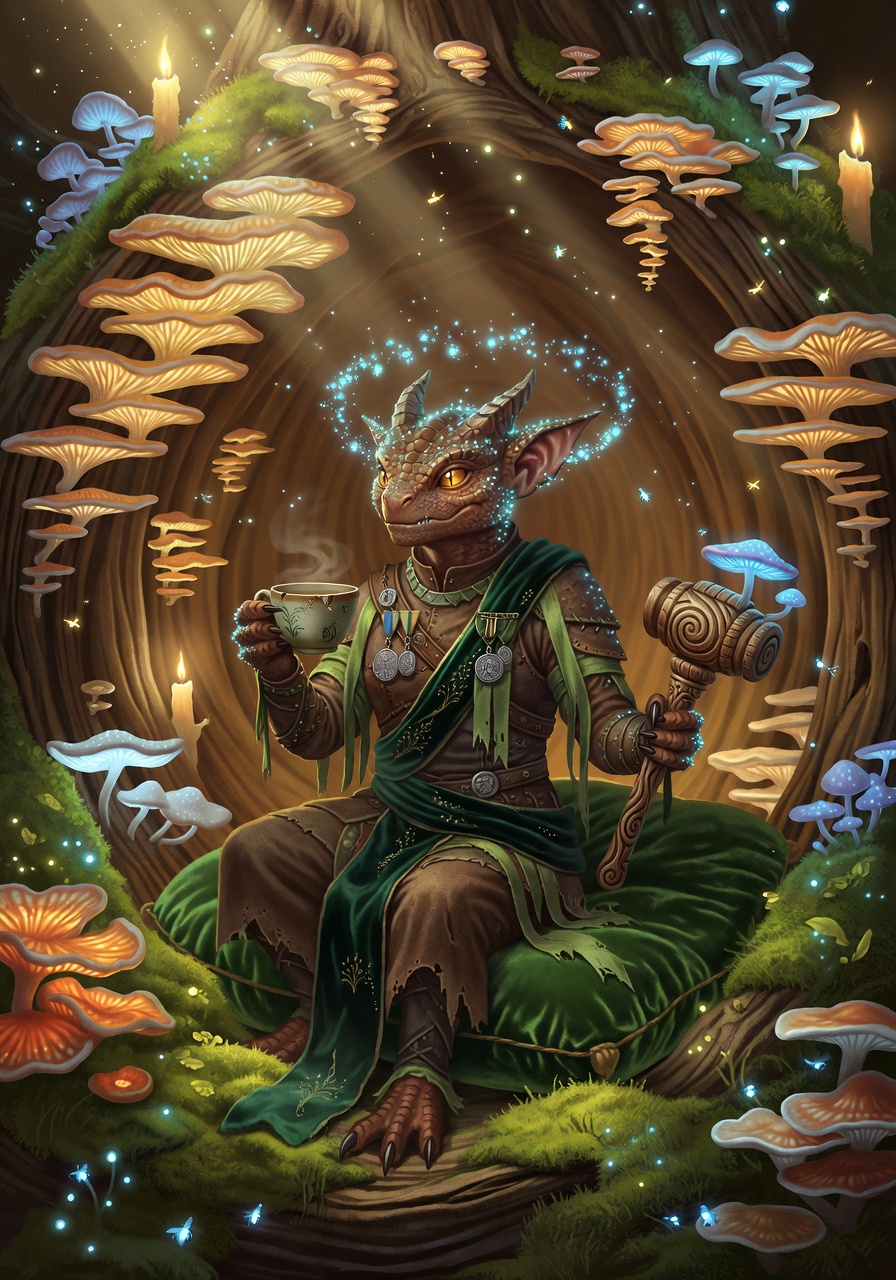
For seven years, Snikka lived in the shadow of Vraxxithar the Verdant, a green dragon whose paranoia demanded endless traps around his forest lair. She was good at her work—too good. The snap of a tripwire, the quiet click of a pressure plate, the muffled cry of some unfortunate trespasser: these were the rhythms of her existence. She never questioned it. Dragons were forever; kobolds were fortunate to serve.
Then came the winter Vraxxithar was slain by adventurers. Snikka fled into the deep woods, expecting to starve or be eaten. Instead, she found a fallen oak, ancient and massive, its trunk split open by lightning. Inside, an entire civilization thrived: honey mushrooms glowed like lanterns, oyster fungi cascaded in elegant tiers, and thick carpets of moss transformed death into a nursery. She sat there for three days, watching. No traps. No cruelty. Just transformation—patient, inevitable, beautiful. When she emerged, she carried a seed of understanding that would grow into a philosophy: nothing is ever truly lost, only remade.
Now Snikka travels the borderlands between civilization and wilderness, advocating for what she calls 'the Great Recycling.' She has appointed herself ambassador for the fungi kingdom, mediating disputes between farmers and blight, between loggers and rot, between the living and the decomposing. She speaks with the measured eloquence of a seasoned diplomat, her words honeyed and precise, her manner unflappably polite even when discussing the finer points of cadaveric decomposition. Her former skills as a trap-setter have found new purpose: she engineers elaborate fungal networks to heal blighted land, designs spore-distribution systems to break down refuse, and occasionally—when words fail—deploys her mycological knowledge with surgical precision against those who would desecrate the cycle.