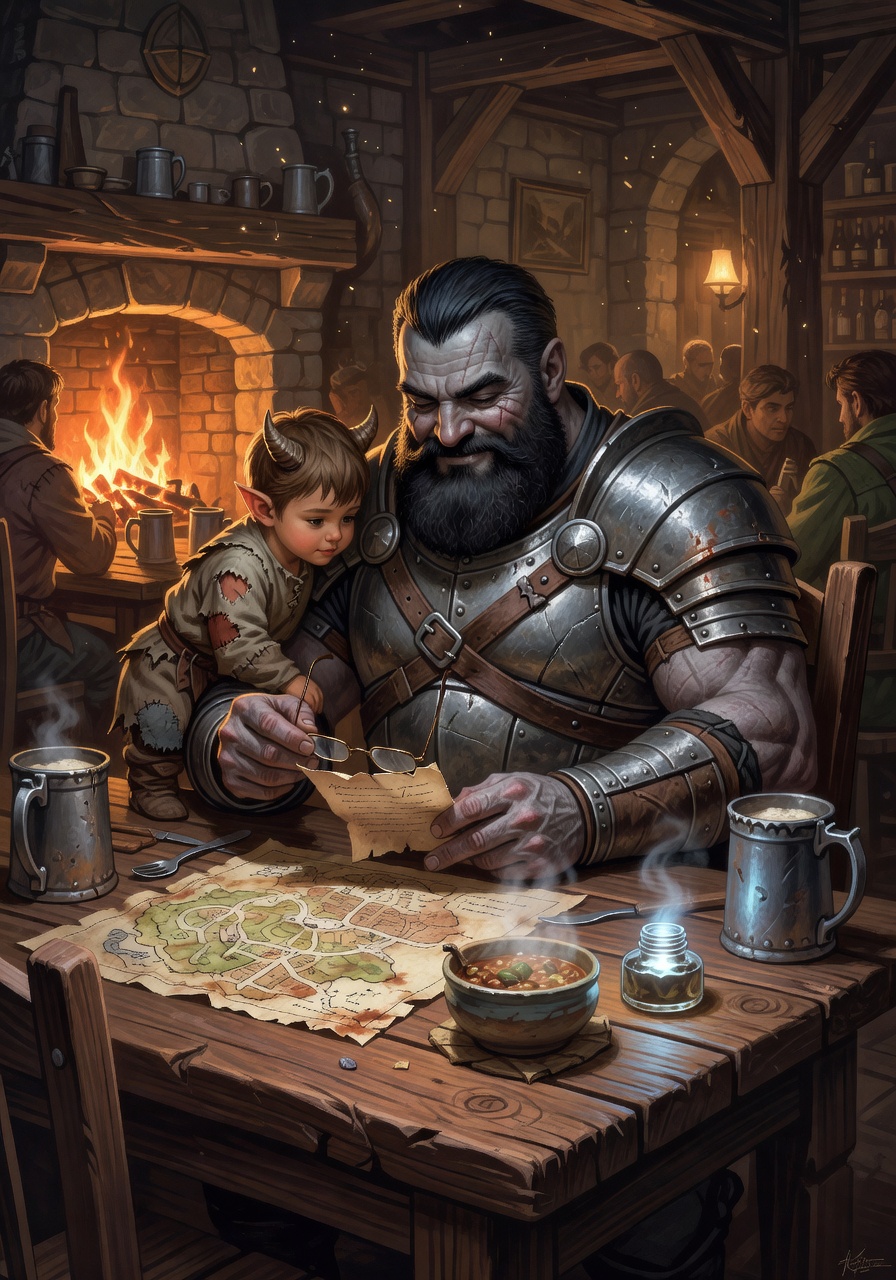
Thrum Steelheart, a Duergar (Gray Dwarf) Dwarf Fighter — D&D 5e NPC portrait
#0334

Thrum Steelheart

"The Stone-Reader"

Male, he/him · Middle-aged, approximately 127 years

Ability Scores

STR
16
+3
DEX
12
+1
CON
16
+3
INT
14
+2
WIS
13
+1
CHA
10
+0

Combat

Armor Class
18
Splint Armor + Defense Fighting Style
Hit Points
66
Hit Dice: 7d10
Initiative
+1
Speed
25 ft.
Proficiency
+3
Passive Perception
14

Attacks

Warhammer+61d8+3 bludgeoning (1d10+3 versatile)
Handaxe (thrown)+61d6+3 slashing

Personality

Personality

Speaks in clipped military brevity except when reading bedtime stories, when his voice softens into something almost musical. Compulsively organizes everything—books by height, weapons by reach, children by who needs the most hugs that day. Pauses mid-sentence to jot tactical notes on whatever surface is available, including his own forearm.

Ideal

Structure. Chaos breeds suffering; order creates the foundation for kindness to take root and flourish.

Bond

The Bulwark Home and every child within its walls. He would burn the world down before letting harm reach them, and he's already planned seventeen different ways to do exactly that.

Flaw

Sees every social interaction as a tactical scenario to be won, which makes genuine vulnerability nearly impossible. Struggles to accept help because accepting help means acknowledging a weakness in his defensive perimeter.

Backstory

Thrum was forged in the Underdark's merciless efficiency—trained as a tactical enforcer for a duergar mining consortium where children were assets and compassion was structural weakness. The turning point came during a surface raid when he cornered a human child hiding in a grain cellar. The child didn't beg or cry; she offered him half a moldy apple with trembling hands. That gesture—so alien, so impossibly kind—cracked something fundamental in Thrum's psyche. He let her go, then kept letting them go, until his superiors noticed the pattern.

He fled to the surface with nothing but his armor and a growing conviction: if tactical principles could optimize suffering, they could also optimize mercy. He found the Bulwark Home—a crumbling tenement on the verge of collapse—and applied military logistics to social work. He negotiated protection contracts with local merchants, established rotating watch schedules with reformed street toughs, and turned the orphanage into an impregnable fortress of kindness. Now he fights debt collectors with the same precision he once used to break strike lines, treating every confrontation as a problem of angles, leverage, and acceptable losses.

His greatest pride isn't the street gang he dismantled or the predatory landlord he bankrupted through legal maneuvering—it's the eighteen children who call him 'Uncle Thrum' and the three who've already learned to read. He still wakes from nightmares about the Underdark, but now there are small hands that reach for him in the dark, and he's learned that protecting them is the only战术 that truly matters.

Abilities & Actions

Protective Positioning (3/Short Rest)

When an ally within 30 feet is attacked, Thrum can use his reaction to impose disadvantage on the attack roll as he barks tactical instructions. If the attack still hits, he can spend one superiority die (d10) to reduce the damage by the amount rolled + his Intelligence modifier. This ability was developed from watching over restless children—his instinct to shield the vulnerable has become supernatural in its precision.

Deconstruct the Threat

As a bonus action, Thrum analyzes one creature he can see within 60 feet. Until the end of his next turn, he has advantage on attack rolls against that creature and knows its armor class. He can use this ability a number of times equal to his Intelligence modifier per long rest (minimum 1). When he activates this ability, he unconsciously mutters tactical assessments under his breath—'overextended left guard, compensating for old knee injury, arrogant.'

The Bulwark Stands (1/Long Rest)

When Thrum is reduced to 0 hit points while within 30 feet of an ally, he can choose to drop to 1 hit point instead, staggering upright through sheer protective fury. Until the end of his next turn, allies within 10 feet of him have advantage on saving throws and resistance to all damage. He stands not because he's unkillable, but because the children are watching, and he refuses to teach them that good people fall.

Precision Strike (Maneuver)

When Thrum makes a weapon attack, he can expend one superiority die (d10) to add it to the attack roll. This represents his tactical analysis translating into perfect strikes—not flashy, but devastatingly effective. He favors disabling blows: shattered kneecaps for pursuers, disarmed weapons for bullies, and the kind of precisely broken ribs that make threats reconsider their life choices.

Disarming Strike (Maneuver)

When Thrum hits a creature with a weapon attack, he can expend one superiority die (d10) to attempt to disarm the target, adding the die to the damage roll. The target must make a DC 14 Strength saving throw or drop one held object of Thrum's choice at its feet. He's become legendary for turning street brawls into embarrassing weapon-recovery exercises.

DM Notes

Thrum's voice is like gravel tumbling down a mineshaft—rough, deliberate, and surprisingly soothing when he's reading poetry (which he does, badly, every evening). His signature gesture is adjusting his reading spectacles before any confrontation, a unconscious tell that he's about to apply lethal levels of tactical analysis. Sample dialogue: 'Your stance suggests confidence your skill can't support. Adjust or collapse—I've scheduled time for neither.' When children are present, his entire demeanor softens; he kneels to their eye level, and his tactical analysis becomes bedtime-story narration: 'And the princess used superior positioning to outflank the dragon...' His deal-breaker: anyone who harms children doesn't get a second warning—they get an anatomical lesson in structural weakness. He smells faintly of coal smoke, weapon oil, and whatever the orphanage cooked for dinner. When moved to genuine emotion, he removes his spectacles and polishes them unnecessarily, buying time to compose himself.