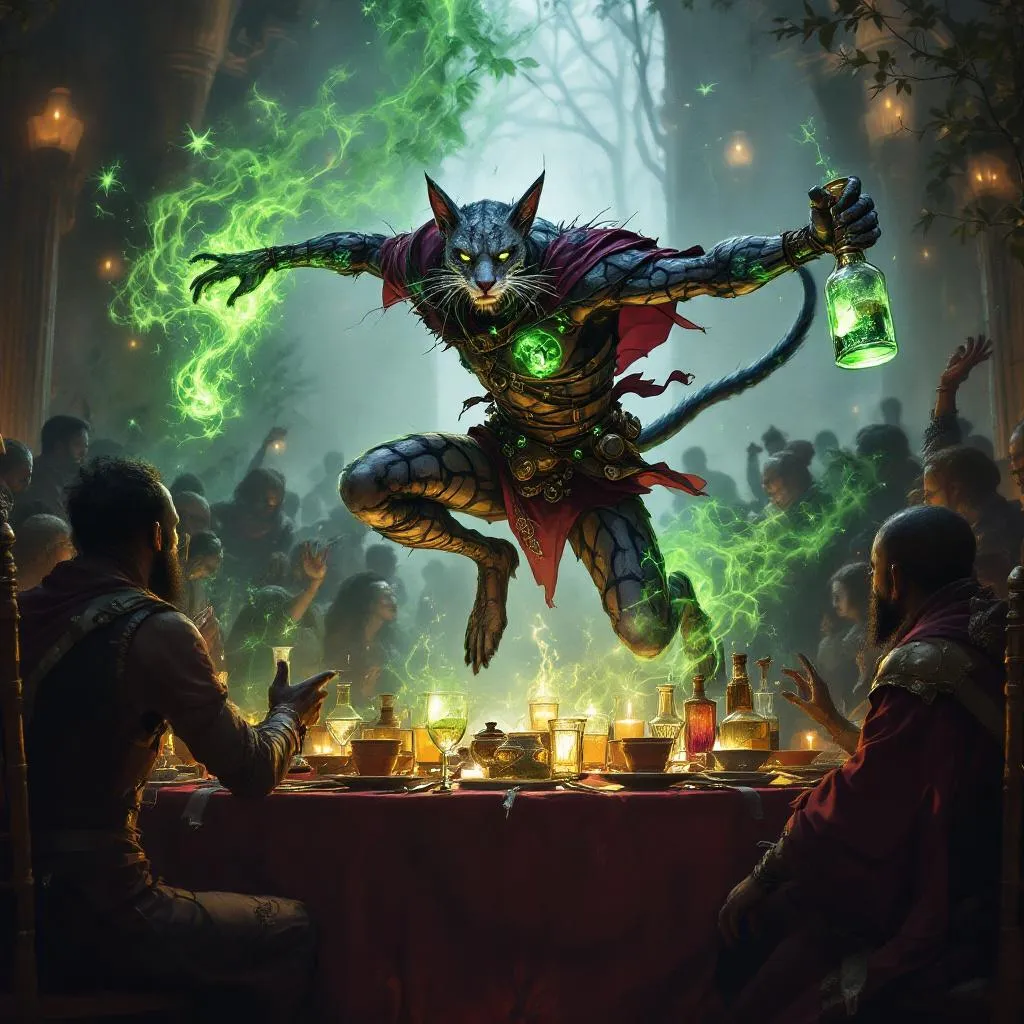
Mottle Sevenleap, a Tabaxi Blood Hunter — D&D 5e NPC portrait
#0356

Mottle Sevenleap

"the Unmoored Scholar"

They/them, fluid presentation · Middle-aged, approximately 38 years

Ability Scores

STR
12
+1
DEX
18
+4
CON
14
+2
INT
16
+3
WIS
13
+1
CHA
10
+0

Combat

Armor Class
16
Studded leather armor + DEX modifier
Hit Points
56
Hit Dice: 7d10
Initiative
+4
Speed
30 ft., climb 20 ft.
Proficiency
+3
Passive Perception
14

Attacks

Crimson Rite Scimitar+71d6+4 slashing + 1d6 fire (Rite of the Flame)
Hand Crossbow+71d6+4 piercing

Personality

Personality

Mottle tilts their head at impossible angles when listening, pupils dilating at different rates, and unconsciously licks the back of their hand while thinking. They speak in precise, academic language peppered with field notes—'Fascinating. Your ale contains trace amounts of wormwood. Third batch this month? The brewing mold may be contaminated.' They compulsively sketch in the margins of every book they touch, annotating cultural observations with the clinical detachment of a surgeon and the tenderness of a poet.

Ideal

Preservation — Cultures are living ecosystems. When traditions become parasites that kill their hosts, someone must intervene, even if it means becoming the monster in their mythology.

Bond

The collection of stolen artifacts hidden in Mottle's sanctum—a glowing urn, a cursed harvest scythe, a ceremonial mask that whispersnames of the dead. Each represents a community saved from itself, and a home Mottle can never return to.

Flaw

Mottle cannot stop changing. Even when not strictly necessary, they drink new mutagens, chasing the phantom sensation of 'fitting in' they felt for one perfect week in a halfling vineyard seven years ago. Their body is a palimpsest of failed experiments, and they are terrified that one day they will transform into something so alien that even they won't recognize what they've become.

Backstory

Mottle began as Dr. Mottle Sevenleap, a promising young anthropologist whose dissertation on 'The Physiology of Belonging' was celebrated in academic circles from Candlekeep to Silverymoon. But reading about cultures felt hollow compared to living within them. They joined the Order of the Mutant not to hunt aberrations, but to remake themselves—to drink the alchemical keys that would unlock every door, adapt to every custom, and finally answer the question that haunted their sleepless nights: where do I belong?

A decade of self-inflicted transformation followed. Mottle has walked among frost giants during the Long Dark, their blood thickened against the cold. They have breathed underwater with merfolk traders, gills opening along their ribcage for three agonizing weeks. They have survived the Elemental Chaos itself, their fur briefly crackling with static fire. Each mutagen brought them closer to understanding—and further from recognition. Their once-beautiful clouded leopard pattern is now a patchwork canvas of chemical stains: indigo veins from a failed experiment with drow poison resistance, neon-green streaks from adapting to underdark fungal spores, silver patches where they tried to metabolize lycanthropic essence. Their pupils dilate and contract independently, struggling to focus, and their voice sometimes echoes as if spoken from two throats at once.

The cruelest discovery came in a village they loved. Mottle had spent months learning the dialect, the dances, the way they blessed bread before breaking it. Then they realized the annual Harvest Benediction—the sacred festival that defined the community—was slowly poisoning the aquifer. The ritual centerpiece, a blessed urn containing 'ancestral spirits,' was actually leaching arsenic into the groundwater. When Mottle brought evidence to the elders, they were dismissed. So Mottle did what any good anthropologist would do: they stole the urn mid-ceremony, fled into the night, and became the villain in someone else's story. They've been running ever since, carrying relics and artifacts away from the cultures they were meant to protect—not out of greed, but out of love. Mottle is a traitor to every law, but faithful to every land.

Abilities & Actions

Mutagenic Adaptation (3/day)

As a bonus action, Mottle drinks a prepared mutagen, gaining one of the following effects for 1 hour: (1) Celerity: +3 to AC, advantage on Dexterity saving throws. (2) Potency: +3 to melee damage rolls, advantage on Strength checks. (3) Sagacity: +3 to spell save DC, advantage on Intelligence checks. (4) Cultural Mimicry (unique): Advantage on all Charisma checks to blend into a specific culture or social setting, and the ability to speak one language chosen when drinking the mutagen. Side effect: Each mutagen leaves visible discoloration on Mottle's fur (DM's choice of color) that fades after a long rest.

Blood Curse of the Exorcist (1/turn)

When a creature Mottle can see within 60 feet is possessing another creature or being possessed, Mottle can use their reaction to amplify their hemocraft. The possessing entity must succeed on a DC 14 Constitution saving throw or take 2d6 psychic damage and be forced out of the host body into the nearest unoccupied space. If amplified (taking 2d6 damage themselves), the possessing creature is also stunned until the end of Mottle's next turn.

Feline Agility (Recharge after moving 0 feet)

Mottle can double their speed (to 60 feet) until the end of their turn. Once used, they must move 0 feet on one of their turns to regain this trait, representing the predatory stillness before the pounce.

Anthropologist's Insight (At Will)

Mottle can spend 10 minutes observing a social gathering, religious ceremony, or community interaction to make a DC 14 Intelligence (Investigation) check. On a success, they discern one hidden truth about the culture: a secret tradition, a deceptive practice, a concealed hierarchy, or an unspoken taboo. This often reveals information NPCs would never willingly share with outsiders.

Relic Extraction (1/long rest)

When Mottle identifies a cursed, poisonous, or magically corrupted object central to a community's suffering, they can perform a 1-minute ritual to 'extract' it safely. Make a DC 14 Intelligence (Arcana) check. On a success, the object's harmful effects are suppressed for 24 hours, and Mottle can remove it without triggering defensive magic or cultural backlash. On a failure, the object's curse affects Mottle directly (DM's choice of effect, typically a level of exhaustion or temporary madness).

DM Notes

Mottle's voice is a soft, scratchy purr that occasionally splits into an unsettling harmonic—like two people speaking slightly out of sync. When nervous, they groom their multicolored fur compulsively, tongue rasping over the chemical stains they can never quite clean. Their signature gesture is the 'anthropologist's tilt': head cocked at 45 degrees, one ear swiveling forward, pupils contracting to slits as they catalog every detail of a scene. In conversation, they say things like, 'Your wedding vows share grammatical structure with a binding curse—third declension, contingent clause. Coincidence? Unlikely.'

Mottle reacts to hostility with clinical curiosity rather than fear. When threatened, they ask, 'Is this ritualized aggression or genuine intent to harm? Your stance suggests the former, but your grip contradicts your body language.' They will flee rather than fight if the stolen artifact they carry is at risk—Mottle can always make new friends, but they cannot replace the glowing urn that represents six months of fieldwork and a village's survival.

Deal-breaker: If someone dismisses cultural preservation as 'just tradition,' Mottle will disengage entirely, fur bristling. 'Tradition is memory made flesh. You wouldn't amputate a limb because it's 'old,' would you?' If pressed, they will leave mid-sentence, muttering field notes about 'cultural amnesia' and 'willful ignorance.' However, if someone shows genuine care for a community's wellbeing—even if they disagree with Mottle's methods—Mottle will listen with those mismatched pupils fully focused, desperate for someone who understands.