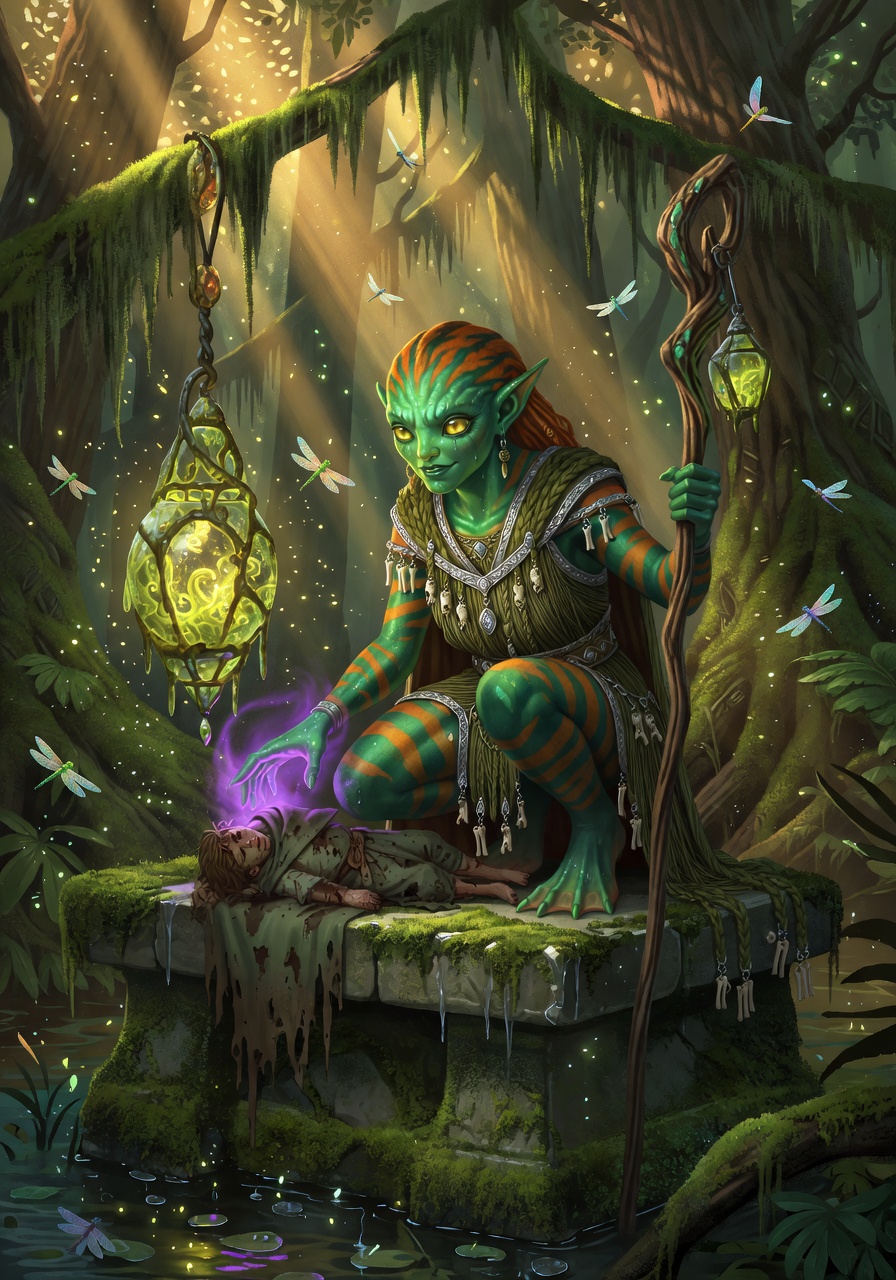
Zrip-Zrip was born into the green caste of her colony — the warrior class — and was expected to die young in territorial skirmishes like all her siblings. But when a plague swept through the tree-villages, she alone refused to abandon the dying. She watched her kin molt their final skins in agony, clawing at infected flesh, and something in her broke and reformed. She began experimenting with necrotic magic not to kill, but to numb — to deaden nerve-endings, to wither infections before they could spread, to give the dying a peaceful crossing. Her colony exiled her for heresy, calling her magic 'unnatural.' She didn't argue. She simply hopped away into the deep swamp.
Years later, she stumbled upon a crumbling temple to a forgotten death god, its stones thick with moss and memories. Ghosts lingered there — not malevolent, just confused, waiting for someone to tell them it was okay to move on. Zrip-Zrip stayed. She lit her Bog-Glass Lantern (a gift from a dying glassblower she'd comforted) and began speaking to the dead in the soft, croaking lullabies of her people. Word spread. The lost, the sick, the dying — they came. Lizardfolk who'd been cast out. Humans fleeing war. A blind Kenku who just wanted to hear one last song. Zrip-Zrip didn't turn anyone away. She built what her people never gave her: a place where every ending mattered.
Now she leads a refuge of two dozen souls who call her 'Mother,' though she insists she's far too small and much too busy for the title. She teaches them her philosophy: that death is not a punishment but a sacred transition, and that every creature — no matter how small, how strange, how 'wrong' — deserves to face it with dignity. She still hums the lullabies. The ghosts have mostly moved on, but new ones always arrive, and Zrip-Zrip greets each one the same way: 'Welcome, little sibling. Let me show you how beautiful your final molting can be.'