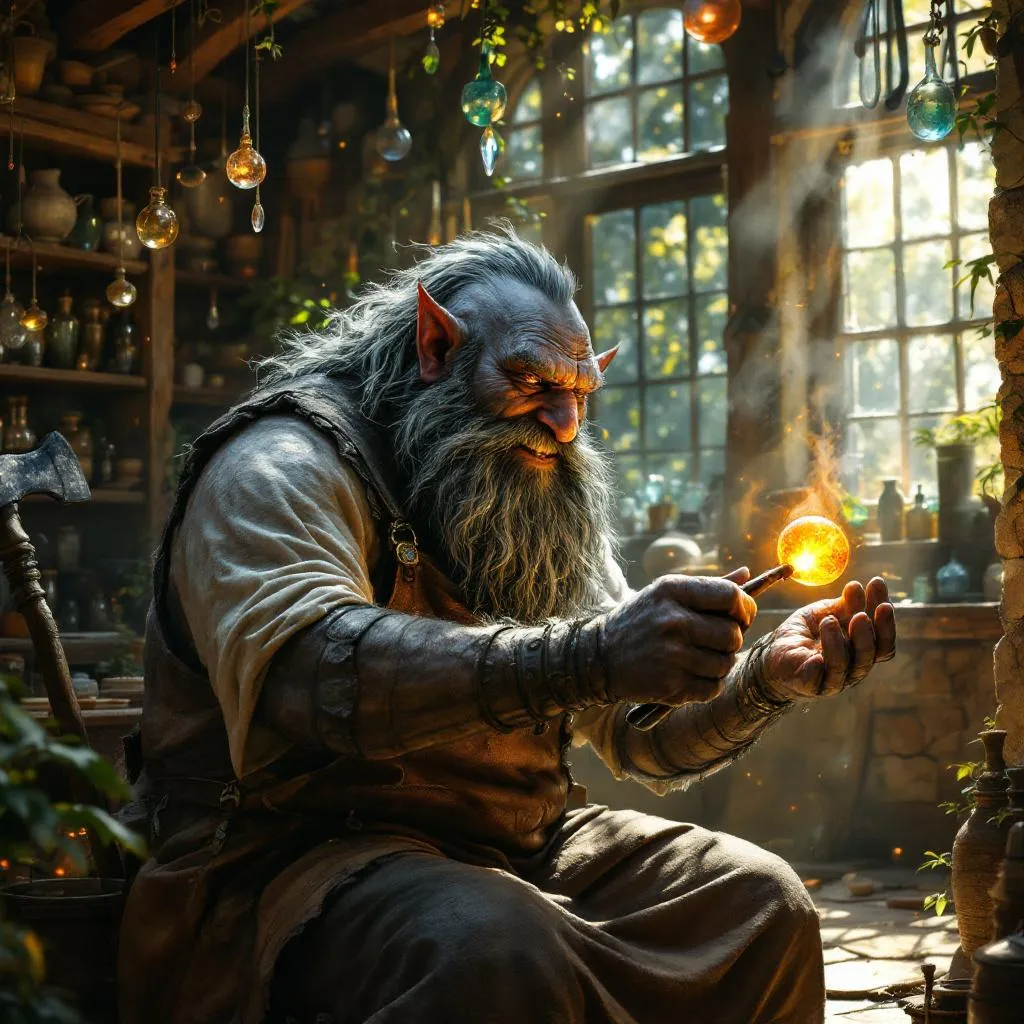
Thistlewick learned his craft in the hidden glens of the Whispering Forest, where Firbolg masters taught that beauty and function were inseparable truths. For decades, he created works that kings and commoners alike treasured — wine goblets that caught starlight, windows that sang in the wind, delicate hummingbird ornaments that seemed ready to take flight. His workshop became a pilgrimage site for those who understood that true art required both strength and gentleness.
The turning point came when a border skirmish destroyed a village where his glasswork had adorned every home. He arrived to find not just shattered windows, but shattered families — children orphaned, elderly left without support, friendships severed by accusations and grief. He spent weeks mending what glass he could, but the cracks remained visible. The people remained broken. That night, watching fireflies dance among the ruins, he understood: a vase could be made whole again with heat and patience, fitted back together stronger than before. But a severed life left only absence.
Now Thist wanders the borderlands with his glass-blowing iron repurposed as a quarterstaff and his maul slung across his back. He positions himself between escalating conflicts like a master glassblower controlling flame — redirecting momentum, cooling volatile tempers, applying pressure at precise points to prevent shattering. He doesn't fight to vanquish; he fights to preserve the possibility of repair. Every disarmed weapon is a life he's kept intact. Every tripped charging warrior is a family he's prevented from mourning. He carries a pouch of glass marbles he's made from sand gathered at battlefields — each one a reminder that even the most broken places can yield something beautiful if treated with care.