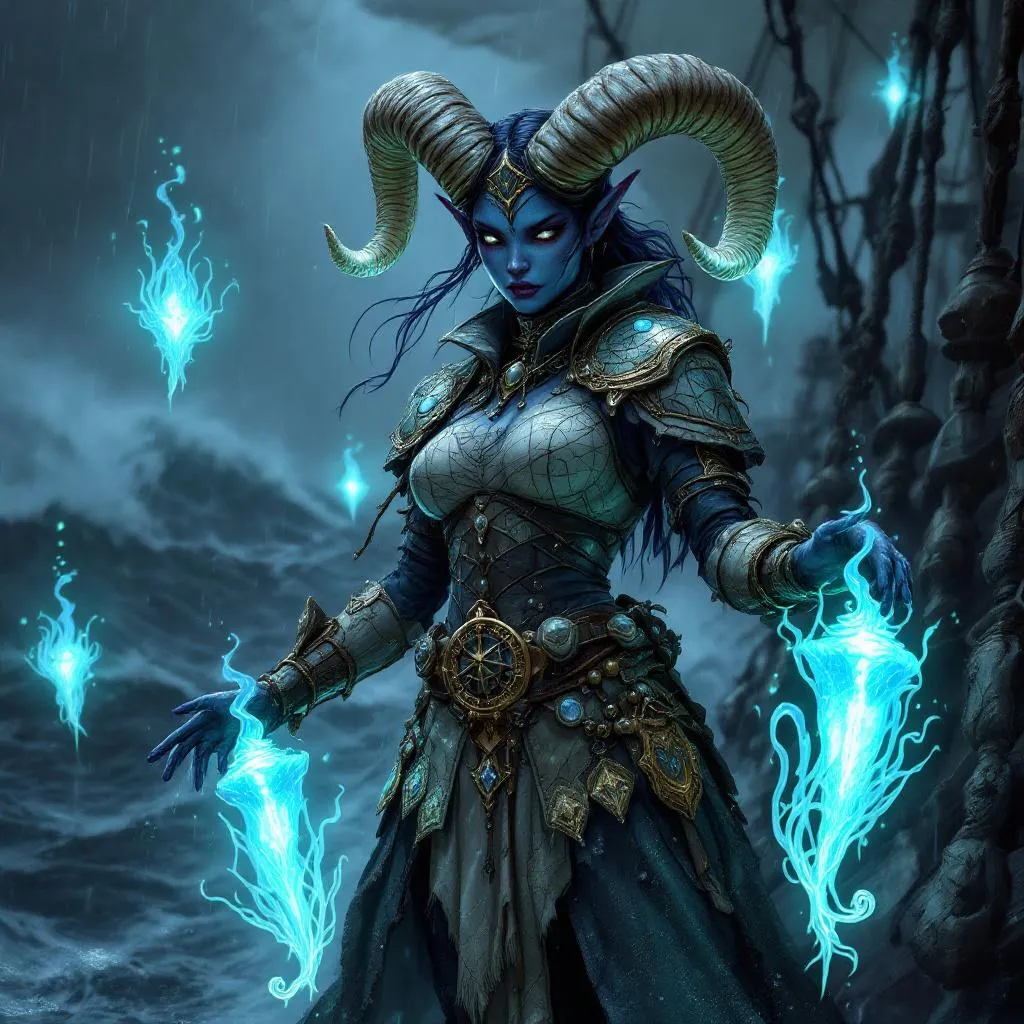
Kallista did not find her calling in the warmth of a hearth or the sanctity of a grove, but in the terrifying, lightless pressure of the Midnight Zone. Following a catastrophic shipwreck that claimed her entire research expedition, she spent three days drifting in a capsized hull. While others prayed to gods for salvation, Kallista watched the rhythmic pulse of bioluminescent jellyfish and realized the ocean wasn't a monster—it was a machine. She survived by calculating the exact vector of the subterranean thermal vents, using the heat to stay alive until the currents deposited her precisely onto a sandbar. This clinical realization stripped away her fear, replacing it with an obsessive need to map the logic of the deep.
Now known as 'Salt-Horn' for the brine that perpetually crusts the nautical charts carved directly into her horns, she serves as a ship’s navigator and environmental overseer. She views the crew as mere variables in a much larger equation. To Kallista, a storm isn't a 'wrath of the gods'; it is a localized atmospheric pressure imbalance. She treats the spectral sea-spirits she summons with the same detached professionalism a surgeon treats their scalpels—they are tools for maintaining the fragile equilibrium of the world's most complex engine: the ocean. She travels the Sword Coast not for adventure, but to complete her 'Great Census,' a catalog of every spirit-form that drifts within the salt-spray.