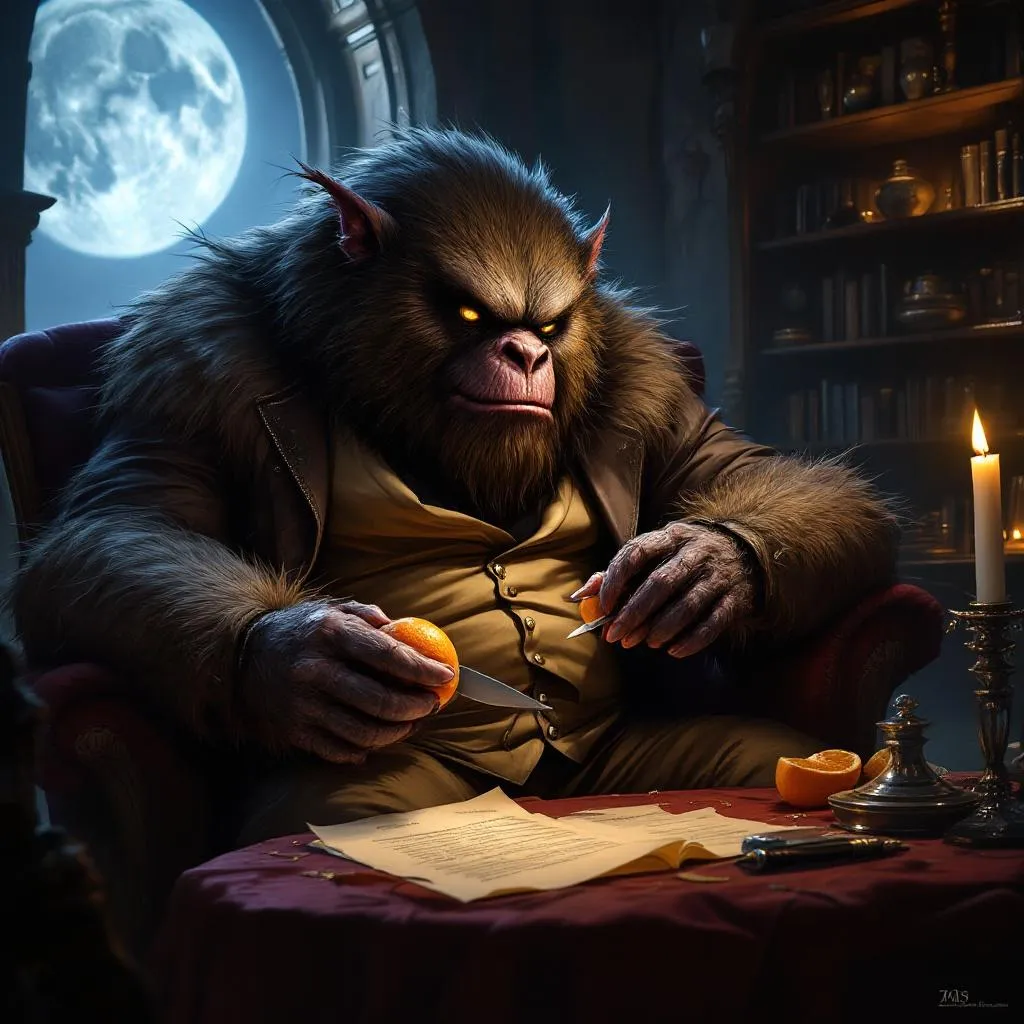
Vuldar 'Silk-Tongue' Gnawbone, a Bugbear Rogue — D&D 5e NPC portrait
#0067

Vuldar 'Silk-Tongue' Gnawbone

"The Architect of Ruin"

Bugbear Rogue (Inquisitive) LE Lvl 5 Courtier (Former Enforcer)

Male (He/Him) · Adult, 34 years

Ability Scores

STR
16
+3
DEX
14
+2
CON
14
+2
INT
16
+3
WIS
12
+1
CHA
16
+3

Combat

Armor Class
14
Custom Silk-Lined Studded Leather
Hit Points
59
Hit Dice: 8d8 + 16
Initiative
+2
Speed
30 ft.
Proficiency
+3
Passive Perception
11

Attacks

Silver-Topped Cane+61d6+3 bludgeoning
Silver Fruit Knife+51d4+2 piercing

Personality

Personality

Speaks in a soft, gravelly baritone; handles fragile objects with exaggerated, unnerving precision; never interrupts.

Ideal

Order. Chaos is for the small-minded; a well-regulated society allows the truly clever to harvest the weak.

Bond

The 'Black Ledger', a collection of every secret he has ever curated, kept in a cipher only he understands.

Flaw

He is addicted to the feeling of intellectual superiority and cannot resist explaining a victim's ruin to their face.

Backstory

Vuldar was born to the Gnarled Fist tribe, where his unusually long reach was valued only for how many skulls it could crack at once. He spent a decade as a 'heavy' for Baron von Kraul, a man who treated Vuldar like a trained bear. The shift occurred when Vuldar found a discarded ledger in the Baron’s trash; while his kin would have used the parchment for kindling, Vuldar taught himself to read. He realized that the Baron’s power didn't come from the guards or the stone walls, but from a fragile web of numbers and lies. When the Baron ordered Vuldar to execute a local baker for unpaid debts, Vuldar didn't kill the man—he taught the baker how to file a formal grievance with the royal excise office.

The resulting scandal didn't just ruin the Baron; it erased him. Vuldar watched from the shadows as the man he once feared was stripped of his titles and hauled away in chains. He realized then that violence is a blunt, inefficient tool. Now, Vuldar moves through the high courts of the capital, his massive frame squeezed into bespoke silk waistcoats. He has become the city’s most dangerous confidant, a creature who trades in the currency of shame. He maintains a veneer of absolute, terrifying politeness, but those who look into his yellow eyes see the same cold hunter that once stalked the forests—he has simply traded the woods for the parlor.

Abilities & Actions

Long-Limbed Etiquette (Passive)

Vuldar adds 5 feet to his reach when he makes a melee attack or uses a delicate object (like his silver fruit knife or pouring tea). He has advantage on Dexterity (Sleight of Hand) checks made to manipulate objects within 10 feet of him without being noticed.

Clinical Curiosity (Bonus Action)

Vuldar makes a Wisdom (Insight) check against a creature he can see within 30 feet, contested by the target’s Charisma (Deception) check. If he succeeds, he identifies a psychological fracture. For 1 minute, Vuldar deals an extra 14 (4d6) psychic damage to the target the first time he hits it with an attack on each of his turns, as he strikes precisely where they feel most vulnerable.

The Silver-Topped Cane (Action)

Melee Weapon Attack: +6 to hit, reach 10 ft., one target. Hit: 6 (1d6 + 3) bludgeoning damage. If Vuldar has advantage on the attack roll, the target must succeed on a DC 14 Wisdom saving throw or be Charmed by Vuldar until the end of its next turn as he whispers a crushing secret into their ear.

Architect of Ruin (Reaction)

When a creature within 30 feet of Vuldar misses an attack roll against him, Vuldar can use his reaction to whisper a devastating truth about the attacker's past. The attacker has disadvantage on all attack rolls and ability checks until the end of its next turn.

DM Notes

Vuldar always offers tea or fruit before a negotiation. His signature gesture is peeling a blood-orange with his silver knife without breaking the spiral of the rind. If a player tries to intimidate him, he simply smiles and mentions the name of a person they haven't thought of in years. He will never initiate physical combat unless his life is in immediate danger; he prefers to watch his enemies destroy themselves.