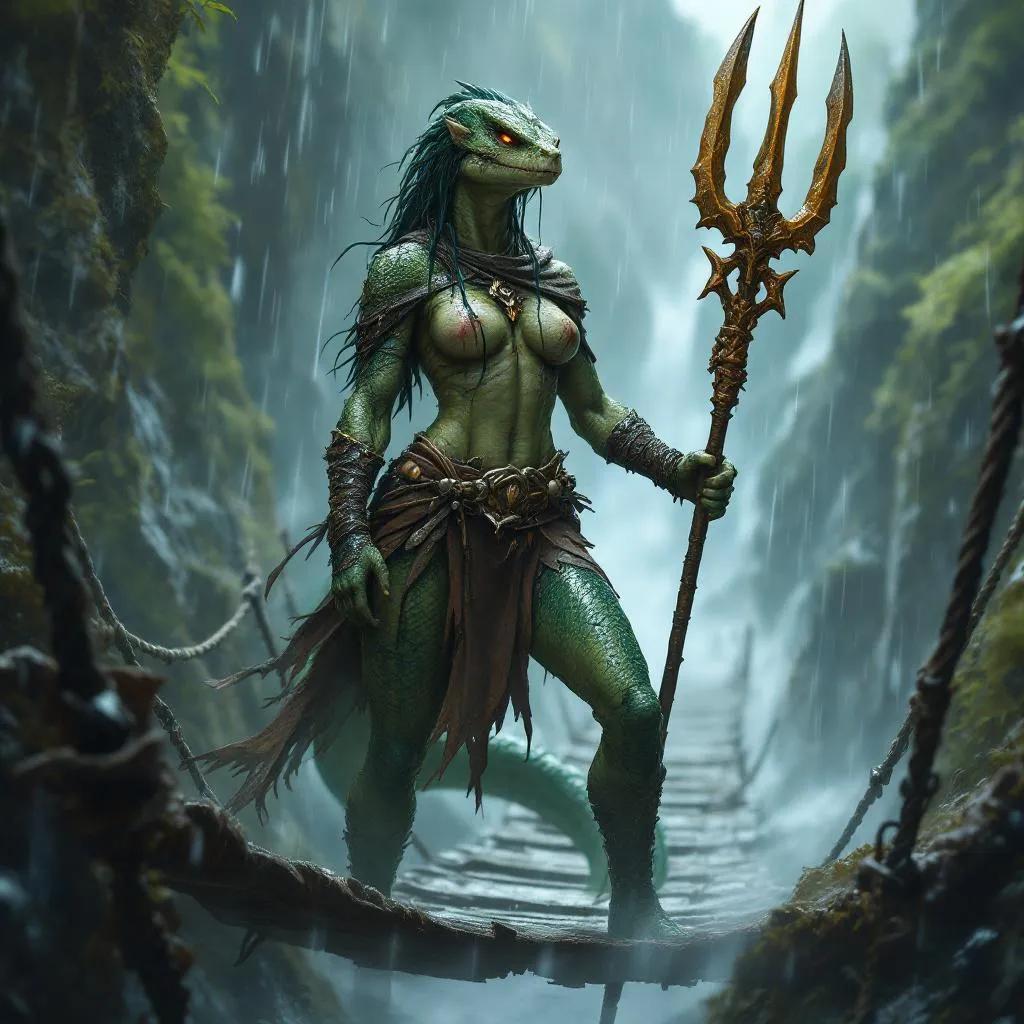
The night Ss'thar-ia earned her exile, the moon hid its face as if unable to witness what transpired. She knelt in the ritual circle, scaled hands trembling as her serpent-kin prepared the fisher-folk for sacrifice — eleven souls bound and weeping, offerings to Sseth the Sibilant Death. Her people expected her to cut the first throat. Instead, she felt the ocean's fury rise within her, a rage so pure it drowned out the whispered commands of her bloodline. The petrified coral trident, meant to consecrate the slaughter, became salvation in her hands. By dawn, seven yuan-ti lay dead by her weapon, and the villagers fled to safety across waters still red with serpent blood. Her own mother placed the bounty on her head, bisecting Ss'thar-ia's throat tattoo with a dagger before she escaped — a permanent mark of her severed ties.
She has spent four years since that night wandering coastal villages, offering her trident and her fury to those who need protection from the monsters she knows all too well. The rage that saved those first eleven souls terrifies her. When it rises, she sees her father's eyes in her reflection — the same cold calculation, the same predatory focus, just aimed at different prey. She keeps the wooden bird totems villagers carve for her, twenty-three now, wrapped in oilcloth. On the nights when ancestral whispers promise her that violence is simply her nature, she unwraps them one by one, counting the lives her cursed fury has saved. The serpent cults still hunt her. Her mother still dreams of dragging her back to the altar. But Ss'thar-ia has learned that some debts can only be paid forward, one saved life at a time, until the blood on her hands finally runs clear.
She does not ask for forgiveness. She knows her kin too well to believe in it. But she has found something better in the frightened eyes of those she defends — the fragile, revolutionary belief that what you choose to become matters more than what you were born to be.